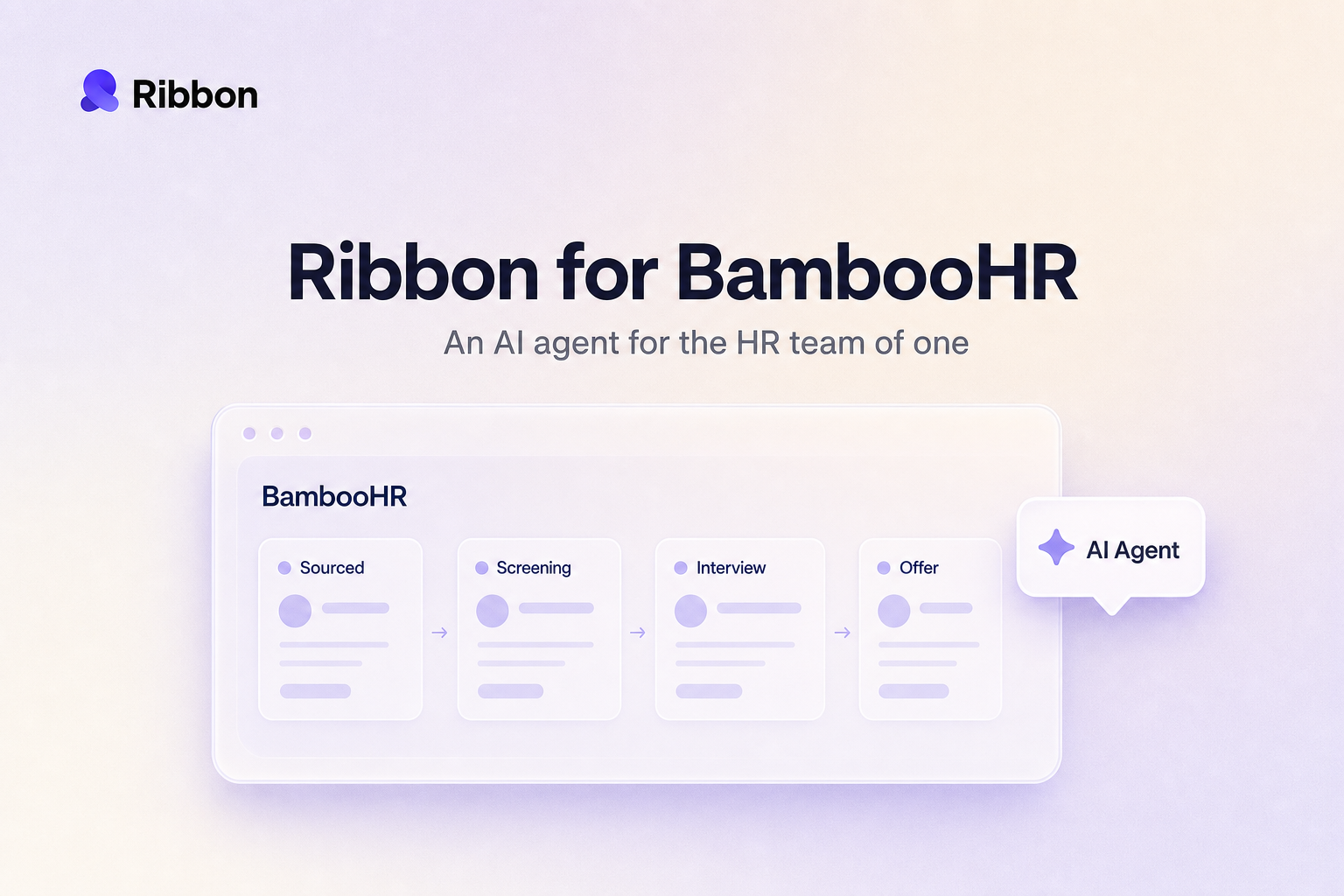
BambooHR was built for the HR generalist running recruiting alongside benefits, payroll, and onboarding. Ribbon plugs an AI agent into the Hiring module so that person stops being the pipeline bottleneck.
Lorem ipsum dolor sit amet, consectetur adipiscing elit, sed do eiusmod tempor incididunt ut labore et dolore magna aliqua. Ut enim ad minim veniam, quis nostrud exercitation ullamco laboris nisi ut aliquip ex ea commodo consequat. Duis aute irure dolor in reprehenderit in voluptate velit esse cillum dolore eu fugiat nulla pariatur.
Block quote
Ordered list
Unordered list
Bold text
Emphasis
Superscript
Subscript
It is 9:14 on a Tuesday at a 220-person company. Open enrollment closes Friday. Three new hires start Monday and one of them still does not have a laptop. There are 47 applicants sitting in BambooHR for two open roles, and the head of marketing has been asking, politely, when she can expect feedback on the design candidate she shortlisted. The person doing all of this is one person. Maybe their job title says HR Manager. Maybe People Ops. Either way, recruiting is one slice of a job that also covers benefits, payroll questions, the occasional culture-deck refresh, and remembering that someone's mother is in the hospital this week.
This is the audience BambooHR was actually built for. Not the dedicated talent acquisition team at a 4,000-person enterprise. The generalist who keeps a 200-person company moving and runs the applicant pipeline as a fourth of a job.
If you are that person, and your hiring lives inside BambooHR's Hiring module, this is what we built Ribbon for. You did not budget for a dedicated AI ops project. You do not have a team of recruiters. You have BambooHR, you have applicants stacking up, and you have an unread tab open to ChatGPT or Claude that you were going to "look at next quarter." Ribbon is the part that makes that tab useful at the actual desk where you work.
MCP, Model Context Protocol, is an open standard introduced by Anthropic in late 2024 that lets AI models read and write data in outside systems through a single interface. Without it, every agent has to hand-roll a connection to every tool. With it, you connect once. Ribbon is an MCP server for your hiring stack. Plug Ribbon into BambooHR once, and any agent that speaks MCP, Claude or ChatGPT or Cursor or the assistant inside your editor, can act on your real applicant data instead of a paste of the JSON you fed it that morning.
BambooHR is HRIS first. The Hiring module sits next to performance reviews, time off, payroll changes, and a directory of every employee. That is not an accident. The applicants you are looking at today are the employees you will be filing I-9s for next month, and BambooHR knows it. An applicant in the Hiring module has a clean handoff into a new-hire record without anyone retyping a phone number.
That single-source-of-truth shape is what an AI agent should respect. Applicants live in the Hiring module, on a job opening, at a status. Status names are configured per pipeline by your admin. The same admin who set up "Phone Screen" and "Take-Home" probably also set up your PTO accruals. When the agent updates a status, it updates the same record your benefits enrollment will read from in six weeks. Generic AI integrations treat BambooHR like a flat list of resumes and lose that thread. Ribbon does not.
Pipeline-side, on the read pass, Ribbon gives the agent live access to your job openings in the same shape BambooHR uses internally, with the recruiting team who owns each one. It sees applicants on each job, with their current status, source, resume, and any custom fields your admin has defined. It sees the status structure your pipeline actually has. If you renamed "New" to "Just In" because that is how your team talks, the agent uses your name, not a generic one. It sees scheduled interviews and the interviewers from your BambooHR directory, and it sees offers extended along with their current state.
What the agent can write back depends on what your admin has authorized. The default is read-only and quiet. When writes are turned on, the agent can create an applicant against an existing job opening, move an applicant to a different status by its real configured name, attach Ribbon-prefixed structured fields with screen scores and per-attribute breakdowns, and add internal notes the recruiting team can audit. Status matching uses the actual configured names on that specific pipeline, so the connection survives the routine renaming every hiring team does mid-quarter.
Each one replaces something that used to live on the HR generalist's plate.
Tuesday morning sweep. You open BambooHR. Forty-three applicants in "New" across two roles. Last Tuesday this was an hour of triage. This Tuesday, the agent has already screened the ones who applied since Friday, written a one-paragraph summary into a custom field on each one, and surfaced the seven you should look at first. The ninety-second filter you used to skim resumes by feel now lives in a column you can sort.
The hiring manager nudge. Your VP of Engineering wants the design lead role moved. The agent pulls everyone in the design pipeline who has been in their current status more than twelve days, drafts a one-line nudge for each, and sends them to your inbox. You decide which to forward. You stop being the queue.
The 3pm "do we have anyone?" question. A founder DMs you: "We are spinning up a customer success role. Anyone in the pipeline already?" The agent reads your applicant pool, cross-references the new role's requirements, and gets you back a list of three current employees who could move internally and four past applicants who scored well on similar searches. You answer in two minutes instead of two hours.
Worth being honest about. Ribbon will not file your I-9s. It will not handle compensation philosophy. It will not tell you whether to fire someone, and it will not write your offer letter from scratch (although it will draft one if you point it at a template). It also does not work outside BambooHR's permission model. If the connecting account cannot see a job opening, neither can the agent. We treat that as a feature.
It is also not a replacement for the BambooHR interface. Your hiring managers will still log in and look at applicants the way they always have. Ribbon adds a second working surface, a conversational one, that sits on top of the same data.
There is no rip and replace. A BambooHR admin authorizes the connection from Ribbon's integrations page. Ribbon subscribes to the right BambooHR events so changes stream in near real time, runs a one-time backfill so history is current, and from there you point any MCP-capable agent at the Ribbon endpoint. Most teams have their first useful workflow live by lunchtime. When you rename a status next month, the agent picks up the new name on the next call, no reconfiguration required.
No. The connection authenticates as the user who set it up, with the BambooHR access that user already has. No new license, no double pricing.
It works, but it is not great. We recommend creating a dedicated service user in BambooHR for the integration. Every action the agent takes is then attributed to a single, auditable account in your activity log instead of to whichever human happened to authorize it.
By default, only the Hiring module data the connecting user can see. If you need agents that can also read directory data, time off, or org chart, that is a separate scope and can be turned on per workflow.
Tag a status, a job opening, or a specific applicant as off-limits and writes are blocked at the Ribbon layer before they ever reach BambooHR.
Two ways. Writes only happen through explicit tools, so a read pass cannot mutate anything by accident. And every write is attributed to the connecting user in BambooHR's audit log, so you have a real record if you ever need to roll something back.
No. When the applicant becomes a hire, BambooHR's existing handoff into the employee record runs the same way. Ribbon sits on the recruiting side and does not change anything about how Hiring transitions into HR.
The first version of the BambooHR connector is read-heavy and write-careful, on purpose. On the roadmap: richer custom-field mapping for screen results, status-aware notifications that ride the same channels your existing BambooHR alerts already use, and a tighter handoff into onboarding once an offer is accepted. If you are running BambooHR for hiring and there is a workflow you want an agent to take off your plate, send it to us. The next release probably has it.
You can connect from the integrations page at ribbon.ai. Setup runs about five minutes. The Tuesday morning sweep tends to work first.

Natural-sounding AI interviews that candidates actually enjoy
Instant feedback and scoring for every candidate
24/7 availability. Never lose a candidate to scheduling delays

"Ribbon AI reduced our time-to-hire by 60% while improving candidate experience."
- Sarah M., Head of Talent
See why teams are switching to smarter hiring.
7-day free trial • Cancel anytime


