Healthcare and field service hiring teams get asked harder questions about candidate data than most. This guide shows talent leaders what to review before rollout: consent, access, recordings, summaries, and the exact point where human judgment still needs to take over.
Lorem ipsum dolor sit amet, consectetur adipiscing elit, sed do eiusmod tempor incididunt ut labore et dolore magna aliqua. Ut enim ad minim veniam, quis nostrud exercitation ullamco laboris nisi ut aliquip ex ea commodo consequat. Duis aute irure dolor in reprehenderit in voluptate velit esse cillum dolore eu fugiat nulla pariatur.
Block quote
Ordered list
Unordered list
Bold text
Emphasis
Superscript
Subscript
Healthcare and field service hiring teams usually ask tougher questions about AI than everyone else. They should. When you hire for home health, clinics, regional operations, or technician roles, a screening workflow does not just touch a resume. It can touch contact details, interview recordings, transcripts, summaries, and the final handoff to the people making the decision.
That is why the first compliance conversation should not be about model quality. It should be about operating discipline. What exactly will candidates see? Which team members can access the output? What gets recorded? What can be downloaded? Where does human review happen? And if a team changes its mind, what can be revoked?
Teams hear the phrase AI recruiting compliance and often jump straight to abstract policy language. The more useful questions start with workflow shape, not theory.
In many office hiring environments, an AI screening workflow is reviewed as a speed tool. In healthcare and field services, it is also reviewed as a process control. A team may be screening for shift availability, travel expectations, communication ability, role fit, or whether a candidate can move quickly through a distributed process. What matters is whether the workflow stays reviewable after the interview is done.
That is where a lot of teams get uncomfortable. They are not really worried about the word AI. They are worried about invisible decisions, unclear permissions, and a messy handoff back to the ATS or hiring team. If the only answer you can give is "trust the model," the deal should probably slow down.
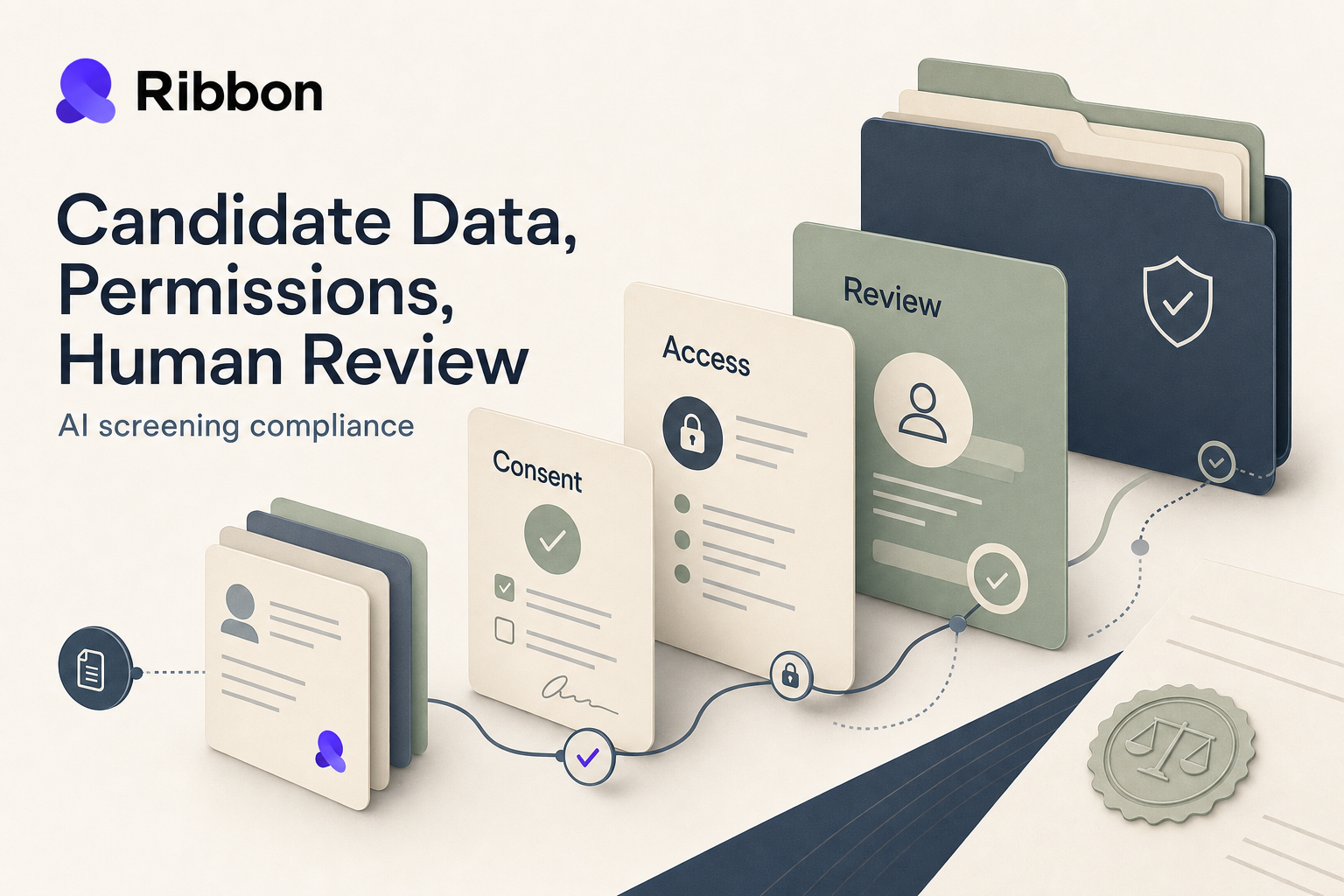
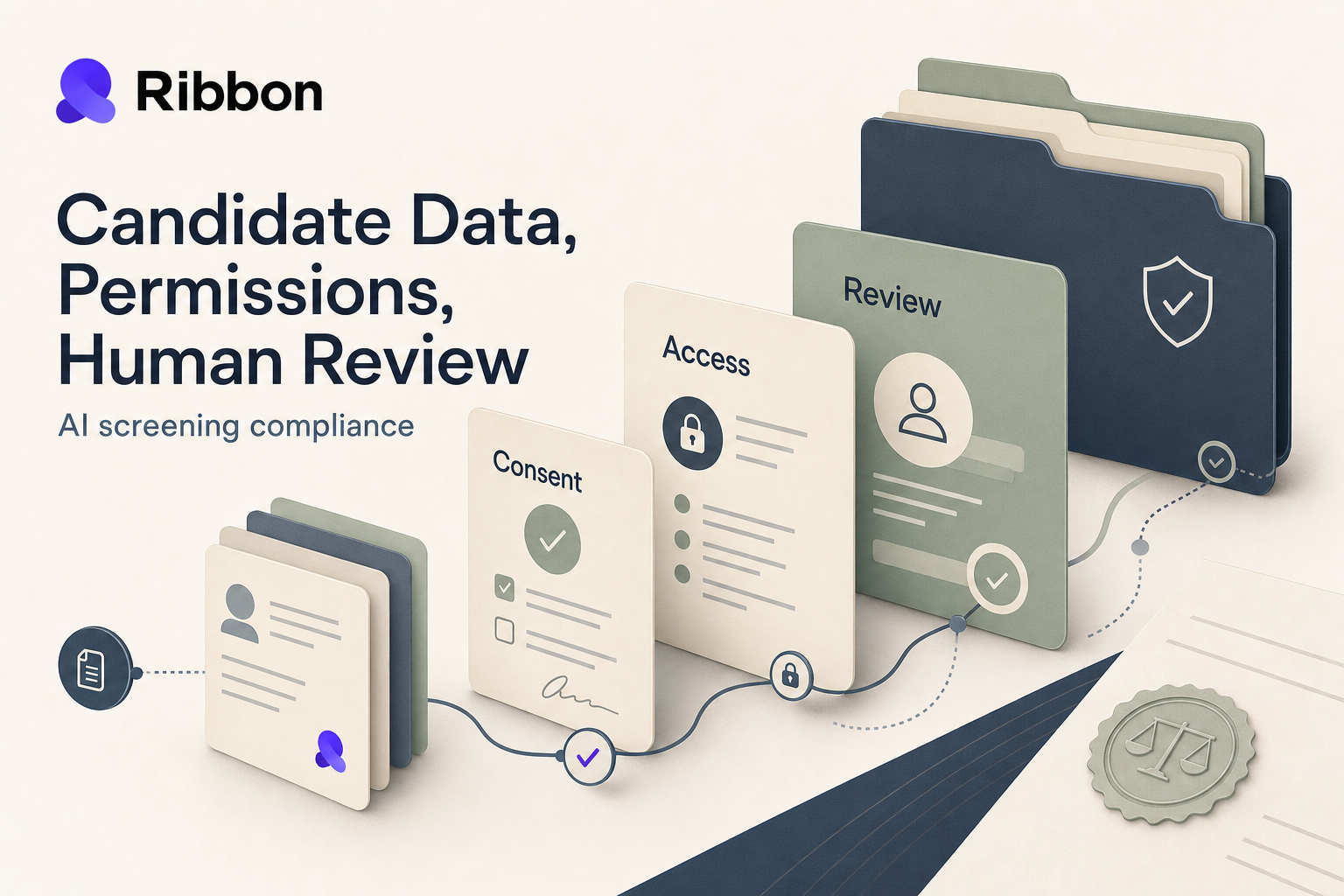
A better answer is operational: candidates see a clear consent step before the interview starts when the organization enables it, admins define the default settings, access is role-based, reviewers can inspect transcripts and summaries, and recordings can be revoked if policy requires it.
Compliance reviews get easier when the data path is concrete. Ribbon's recruiting product surface already suggests the right checklist.
If your organization wants to use AI interviews for nurses, caregivers, technicians, or field reps, the question is not whether data exists. It does. The question is whether every piece of that data has an owner, a purpose, and an access rule.
If your team is still shaping rollout, Ribbon's AI interview rollout checklist for talent ops is a good companion read. If you are evaluating how the product fits into the rest of your stack, the integrations overview is the other place I would send procurement and systems stakeholders first.
The most underrated compliance question in AI hiring is also the least flashy: who can see what?
Ribbon's settings model is useful here because it is opinionated about access. System admins manage organization settings, interviews, integrations, and access. Team-level access can be split into admin, edit, and view roles. That is the right foundation because recruiting data usually should not be exposed with one giant all-or-nothing permission.
For healthcare and field service teams, the nuance matters. A regional hiring lead may need visibility into interview output. A coordinator may need to move candidates through process steps without owning system-wide settings. A compliance or systems owner may want to lock global defaults and allow only limited flexibility at the interview-flow level.
Good governance is rarely about saying no to every exception. It is about deciding which settings stay global and which ones can be adjusted for a specific flow. That gives teams a cleaner answer when different business units have different hiring conditions but still need one defensible standard.
People sometimes talk about human oversight as if it means reading every line after every interview. That is not realistic, and it is not the best control anyway.
The better question is where human review belongs in the workflow. In my view, it should happen at the handoff point where a candidate moves from first-screen evidence to a disposition or next step. That is where summaries, transcript-backed notes, and interview playback matter. The recruiter or hiring lead should be able to see why the system surfaced the candidate, inspect the relevant evidence, and decide what happens next.
This is why I like products that expose more than a score. A reviewable summary is useful. A transcript appendix is better. Timestamped playback is better still, because it lets a human jump to the part that actually shaped the recommendation.
If you want a broader argument for this operating model, Ribbon's post on human oversight in AI hiring makes the same point from a policy angle. I would translate that policy into one workflow rule: no candidate should move forward or out based only on a generated summary that nobody can inspect.
Most AI hiring compliance debates eventually collapse into one practical topic: what do we keep, and who can retrieve it later?
None of those are glamorous product questions. They are still the questions that make an implementation safe.
If I were helping a healthcare or field service hiring team evaluate this category, I would want the buyer, talent ops owner, and compliance reviewer aligned on a short checklist before launch.
A pilot only proves something if the humans on the receiving end can review the output cleanly. If the recruiter, compliance owner, or hiring lead cannot explain why a candidate was recommended, the workflow is not ready, even if completion rate looks great.
For a more general vendor review lens, Ribbon's older AI recruitment vendor compliance checklist is still useful. I would just bring it one level closer to the workflow. Consent, permissions, reviewability, and revocation beat generic promises every time.
Your legal and privacy teams set that policy. Operationally, the safest approach is to decide it deliberately per organization and per workflow, not assume every role needs the same setup.
Start with the candidate-facing consent text, the permission model, the review surfaces for transcripts and summaries, and the process for revoking recording access. Those four items reveal a lot about whether the workflow is governable.
No. Human oversight is the decision checkpoint where a recruiter or hiring lead can inspect the evidence before acting on it. Good oversight is built into the handoff, not stapled on after the process is over.
Usually not cleanly. High-volume field roles, regulated hiring environments, and leadership hiring often need different controls. The goal is shared standards with intentional overrides, not fake uniformity.
AI hiring tools do not earn trust because they sound careful. They earn trust when the workflow is legible. Candidates can see what they are agreeing to. Teams know who has access. Reviewers can inspect the evidence. And the organization has a clear answer when someone asks what happens next.

Natural-sounding AI interviews that candidates actually enjoy
Instant feedback and scoring for every candidate
24/7 availability. Never lose a candidate to scheduling delays

"Ribbon AI reduced our time-to-hire by 60% while improving candidate experience."
- Sarah M., Head of Talent
See why teams are switching to smarter hiring.
7-day free trial • Cancel anytime


