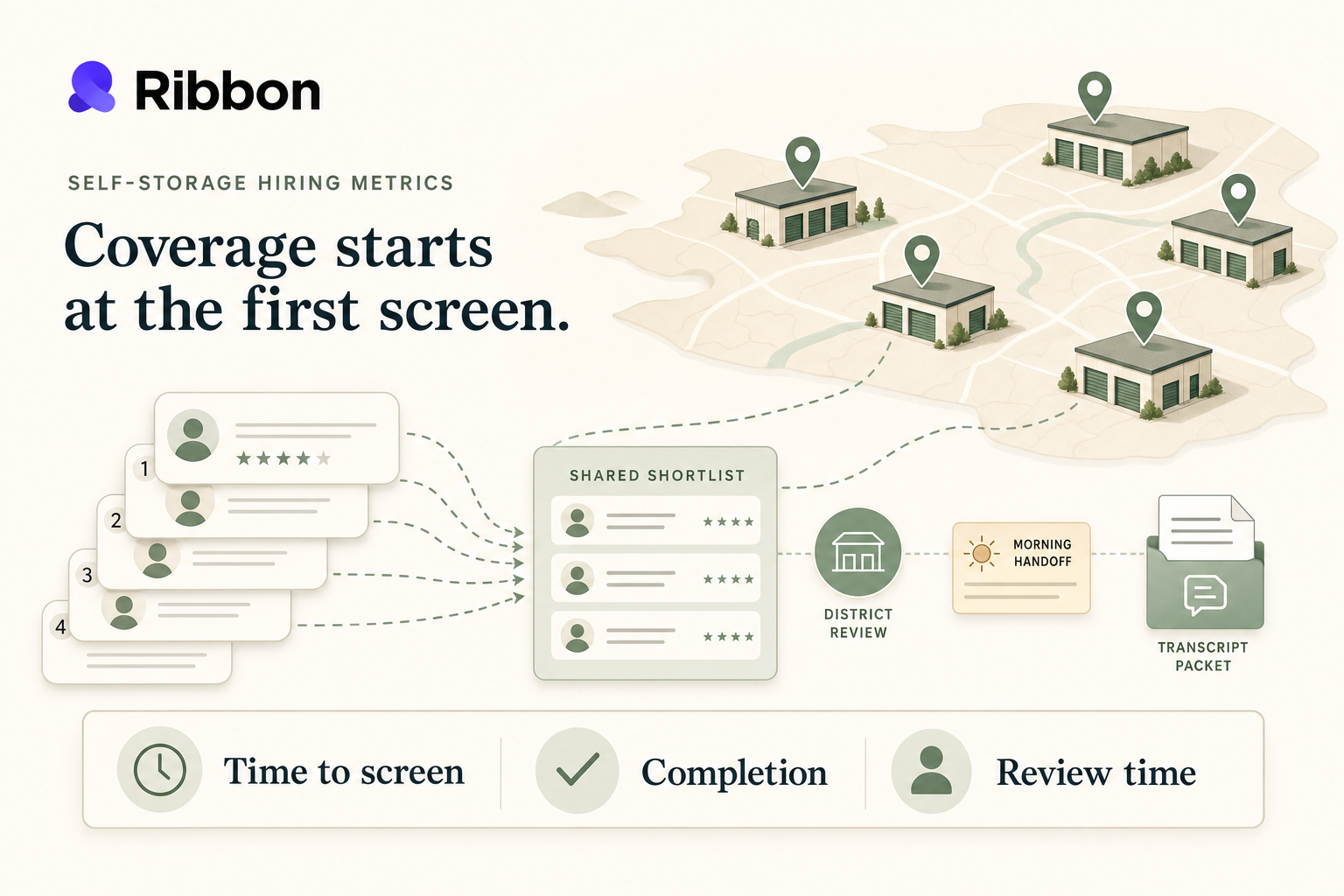
Self-storage hiring rarely breaks in one dramatic moment. It breaks when Saturday applicants wait until Monday, district managers inherit messy handoffs, and weak sites hide inside a network-wide average. These metrics show whether AI screening is actually improving coverage.
Lorem ipsum dolor sit amet, consectetur adipiscing elit, sed do eiusmod tempor incididunt ut labore et dolore magna aliqua. Ut enim ad minim veniam, quis nostrud exercitation ullamco laboris nisi ut aliquip ex ea commodo consequat. Duis aute irure dolor in reprehenderit in voluptate velit esse cillum dolore eu fugiat nulla pariatur.
Block quote
Ordered list
Unordered list
Bold text
Emphasis
Superscript
Subscript
Self-storage hiring usually does not fail because a company has no applicants. It fails because the workflow goes soft in the middle. Someone applies on Saturday night, nobody screens them until Monday, a district manager is covering six facilities, and the first real decision gets buried under a dozen half-reviewed candidates.
That is why I would not start with time to hire alone. It is too slow, too noisy, and too easy to explain away. If you are running self-storage hiring across a portfolio, the better question is whether the first-screen workflow is getting tighter at each site. Ribbon's self-storage hiring page makes the operating model plain: applicants can interview right away, and district managers get a scored packet with the transcript and recording close at hand. The point of measurement is to prove that handoff is actually improving coverage, not just producing prettier dashboards.
Here are the metrics I would track first.
This is the cleanest leading indicator in self-storage hiring. Measure the hours between application submitted and first completed interview. Then cut it by location, weekday versus weekend, and time of day.
The reason is simple. Self-storage applicants often apply outside office hours, and the public Ribbon positioning for this segment leans into exactly that problem: late-night applicants, district managers who need a shortlist by morning, and facilities that cannot wait for a recruiter to come online. If your first completed screen is still arriving the next business day for most sites, the workflow has not really changed.
I would look for three patterns:
Do not hide those outliers inside one blended average. A five-site region can look healthy while one understaffed facility quietly misses every weekend applicant.
A fast invite is not the same thing as a completed screen. You need to know what share of applicants actually finish the interview once it is offered.
For self-storage teams, this number tells you whether the workflow fits the people you are trying to hire. The segment page calls out roles that need reliability, schedule fit, customer-service judgment, communication, sales orientation, and attention to detail. Those are reasonable first-screen criteria, but the interview still has to feel quick and clear enough that applicants complete it before they drift away.
Track completion rate by location and by time window. Then compare it against your old phone-screen baseline if you have one. If a site has strong applicant volume but weak completion, the problem might be the invite timing, the follow-up rhythm, or a screen that asks too much before the candidate sees any payoff.
This is also where Ribbon's broader workflow matters. On the homepage, Ribbon frames the top of funnel as voice interviews plus email and SMS outreach, with results synced back into the ATS. That gives operators a cleaner way to test whether completion changes when the invite channel mix changes, instead of treating every drop-off as a candidate-quality issue.
Self-storage hiring is a multi-site management problem as much as a recruiting problem. A recruiter can move fast and still leave the district manager with a slow handoff. If you only measure interview volume, you will miss that.
Track the time between completed screen and first manager review or decision. Use ATS timestamps if your team records stage movement there. If not, use a simple weekly export and measure when a reviewed candidate gets accepted, rejected, or moved forward. The exact reporting method matters less than the habit.
This metric works because the review packet is where the operational value either shows up or dies. Ribbon's self-storage page says every interview is scored against the questions you set, with the recording and transcript one click away. In the product surface, teams can also download the transcript and a candidate summary, which is useful when a district manager wants the evidence without clicking around a second tool. If review time does not improve, then the packet is either too noisy, too generic, or landing with the wrong owner.
I would rather see a smaller shortlist that gets reviewed same day than a large one that sits untouched until the next regional call.
This is the metric teams try to skip because it forces a real opinion. Do not settle for average score. Decide what a qualified shortlist means in self-storage hiring before the pilot begins.
For one team, it may mean the district manager is willing to schedule an in-person or live follow-up. For another, it may mean the candidate clears availability, customer-facing judgment, and sales-orientation checks without obvious coaching or inconsistency. The key is to define it in business terms, not vendor terms.
Ribbon gives you a few useful inputs here. The workflow supports structured scoring, editable custom scores, transcript-linked review, and integrity monitoring for coached or scripted answers. The regulations material also makes clear that consent and recording notice can be configured before interviews begin, which matters if the hiring team wants reviewers to rely on recordings as part of the decision trail. Put those ingredients together and you can build a shortlist-quality metric that a district manager would actually defend.
If the shortlist-quality rate is flat while screening speed improves, you have learned something important: the workflow is faster, but the rubric or role targeting still needs work.
The most useful self-storage dashboard is not a generic funnel. It is a network view that shows which facilities are still vulnerable.
I would keep one weekly coverage readout with questions like these:
This is where the multi-site angle separates self-storage from simpler hourly hiring. You are not just filling one requisition. You are trying to keep a distributed network staffed without forcing regional leaders to become full-time screeners. The metrics should make weak spots obvious early, while there is still time to adjust the interview design, ATS routing, or follow-up process.
Ribbon's integrations page reinforces the practical part of this. The goal is to work with the ATS your team already runs, not rebuild the system around a new dashboard. A good coverage view should help the operator decide where to intervene next, then push the resulting action back into the workflow the team already trusts.
Not first. Use time to first completed screen and manager review time earlier in the pilot. Those move faster and tell you whether the front of the workflow is getting tighter.
Very few. I would start with screening speed, completion rate, review time, and shortlist quality. Anything more and the report becomes background noise.
Point them to the public regulations page, the bias audit, and your actual interview settings. Ribbon's public compliance material highlights configurable consent screens, explicit recording notice, access controls, and data-handling workflows. That is a much better answer than broad claims about AI safety.
Good looks boring in the best way. Weekend applicants get screened quickly, district managers review tighter packets faster, weak sites stand out sooner, and shortlist quality holds up while coverage improves.
That is the standard I would use. Not whether the dashboard looks modern. Whether the network feels less fragile.
Natural-sounding AI interviews that candidates actually enjoy
Instant feedback and scoring for every candidate
24/7 availability. Never lose a candidate to scheduling delays

"Ribbon AI reduced our time-to-hire by 60% while improving candidate experience."
- Sarah M., Head of Talent
See why teams are switching to smarter hiring.
7-day free trial • Cancel anytime


