When one founder owns recruiting between product calls, a resume queue can feel manageable until it is not. Compare what resumes, live calls, and AI screening actually reveal, then pilot the smallest workflow that gives your team better evidence.

Lorem ipsum dolor sit amet, consectetur adipiscing elit, sed do eiusmod tempor incididunt ut labore et dolore magna aliqua. Ut enim ad minim veniam, quis nostrud exercitation ullamco laboris nisi ut aliquip ex ea commodo consequat. Duis aute irure dolor in reprehenderit in voluptate velit esse cillum dolore eu fugiat nulla pariatur.
Block quote
Ordered list
Unordered list
Bold text
Emphasis
Superscript
Subscript
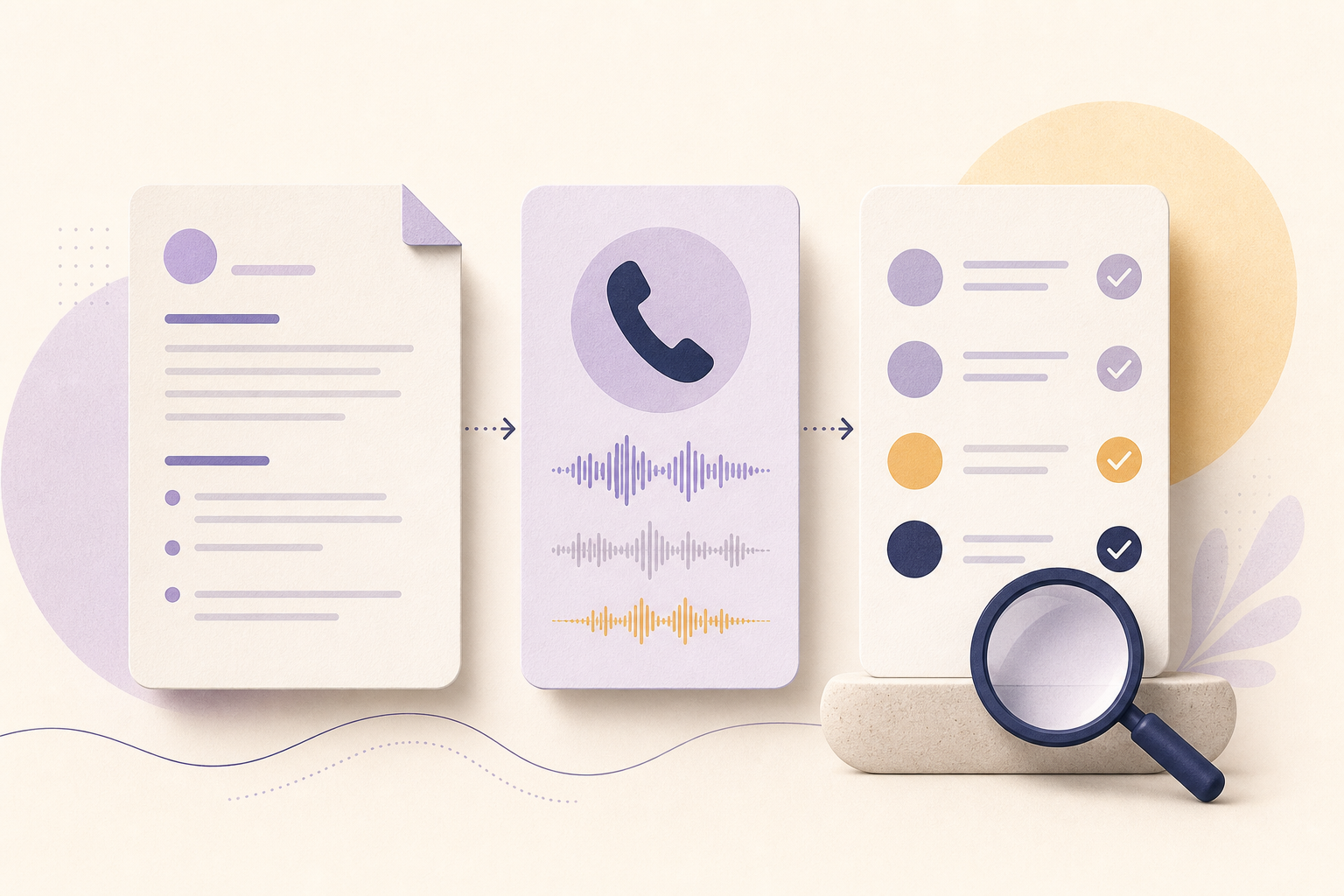
A resume queue can look harmless when you are hiring your first few people. Then a launch slips, someone gives notice, or a strong applicant applies late on a Friday. Suddenly the person reviewing resumes is also the founder who needs to ship, sell, or keep the current team moving.
That is why AI screening for startups is worth comparing with the two habits most lean teams already use: scanning resumes and squeezing in first calls. The question is not which method sounds more modern. It is which one gives you enough evidence to make a good next decision without turning early hiring into a second full-time job.
Resumes are cheap to collect and fast to skim. They are useful for confirming basics such as location, work authorization, relevant experience, or whether a candidate has worked in the kind of environment your role requires. Keep them in the process.
What they rarely tell you is how someone explains a tradeoff, handles an ambiguous customer request, or talks through the work they personally owned. A live first call can surface that context, but it also creates a scheduling loop. The founder or hiring manager has to find a slot, run the conversation, take notes, and decide what belongs in the candidate record. That work is manageable for two applicants. It stops being manageable when the same role attracts twenty people who all look plausible on paper.
Lean teams usually try to fix the pressure with a bigger resume filter. That is understandable, but it can hide people whose experience is less conventional and still strong. A better goal is to separate basic eligibility from the conversation that tests how the candidate thinks. You need both. They simply do different jobs.
Resume review works well as a first pass when the role has non-negotiables. For a sales role, you may need a certain market or deal motion. For an operations hire, you may need a specific license, location, or shift fit. Use a short checklist for those facts so every applicant gets the same pass.
It becomes a weak proxy when the team starts treating formatting, brand-name employers, or a familiar job title as evidence of ability. A polished resume may be a sign of care. It is not proof that a candidate can do the work your team needs next. The opposite is also true. A thin resume can leave out the exact story that would make a hiring manager want a conversation.
A first call can close that gap, but only if the questions are consistent enough to compare answers later. Otherwise each interviewer hears a different version of the candidate and the team ends up debating impressions. That is not a reason to eliminate human calls. It is a reason to reserve them for the point where a human can add judgment, sell the role, or test the detail that only matters to your company.
AI screening is useful when the work between application and first human conversation is repetitive, time-sensitive, and still needs a real answer from the candidate. It should not be a robotic obstacle course. It should be a structured conversation that asks about the role, lets the candidate respond in their own words, and gives the team material it can inspect.
Ribbon's recruiting documentation describes an interview flow that holds the role context, questions, voice settings, and scoring criteria. A candidate receives a single-use interview link, then the team can review the recording, transcript, summary, scores, and hiring votes in one place. That gives a startup a practical middle path: more evidence than a resume, less calendar work than a first call with every applicant.
The setup still matters. Pick questions that would genuinely change the next decision. For an early customer-success hire, ask the candidate to explain how they would handle an account that is frustrated but still valuable. For a founding operations hire, ask for a specific example of untangling a process that had no clear owner. A question such as "Tell us about yourself" may feel friendly, but it does not give much to compare.
If you connect Ribbon to an ATS, confirm the handoff before the pilot begins. Decide which roles trigger an invitation, where the team expects to find the interview result, and who owns any exception. Ribbon lists supported ATS connections, but the useful test is your own candidate record and your own review habits, not a generic integration diagram.
There is a line a startup should keep clear. AI can collect answers, apply a rubric, and put a consistent packet in front of the team. It should not decide who gets hired. A founder, hiring manager, or recruiter still has to judge the context, ask follow-up questions, and own the decision.
That distinction helps with candidate experience, too. Be direct about what the first screen is for, how long it takes, and what happens next. Give candidates a real way to ask for help or an alternative path when appropriate. Then make sure reviewers can see the underlying evidence, not just a single score. A transcript and recording make it easier to spot a poor question, a confusing answer, or a candidate who deserves another look.
I would also avoid measuring a pilot by time saved alone. A shorter process that sends weak evidence to a hiring manager is not a win. Track whether candidates complete the screen, how long reviews wait, how often the team asks for another conversation, and whether the people who move forward are actually worth the time that comes next.
You do not need a company-wide rollout to find out whether this works. Choose one recurring role with enough applications to make the first screen painful but not so much volume that the pilot becomes a staffing project. Write down the current process. Count how long candidates wait for a meaningful response. Note how long reviewers spend trying to reconstruct a first call from their notes.
For one hiring cycle, use the same eligibility check for everyone. Let one group move through the current resume-plus-call process and another complete a structured screen before the human review. Keep the final decision with the same hiring owner. At the end, compare the evidence that reached that person, the time between application and review, and the number of candidates who received a real next step.
The result may be that AI screening is not right for every role. That is a useful outcome. The point of the comparison is to learn where it removes repetitive work without weakening the conversation that makes your company choose well.
It should replace only the repeated qualification layer when that layer is slowing the team down. Use later conversations for role selling, nuance, and decisions that need a hiring manager's judgment.
Ribbon documents role-specific interview flows with customizable questions and scoring criteria. Start with a small scorecard tied to the work, then review a few completed interviews before using it at scale.
Decide that before launch. Your team should know where a reviewer will find the interview result and which person checks that the handoff works during the pilot. The integrations page is a starting point, not a substitute for testing your own workflow.
For a broader look at the category, read Ribbon's guide to what an AI recruiter does. If you are ready to test the ATS side, start with Ribbon's integrations directory and keep the first pilot deliberately small.
Natural-sounding AI interviews that candidates actually enjoy
Instant feedback and scoring for every candidate
24/7 availability. Never lose a candidate to scheduling delays

"Ribbon AI reduced our time-to-hire by 60% while improving candidate experience."
- Sarah M., Head of Talent
See why teams are switching to smarter hiring.
7-day free trial • Cancel anytime


