Ribbon vs. Screenz: compare platform scope, pricing, and workflows across sourcing, rediscovery, outreach, interviews, and ATS operations.
Lorem ipsum dolor sit amet, consectetur adipiscing elit, sed do eiusmod tempor incididunt ut labore et dolore magna aliqua. Ut enim ad minim veniam, quis nostrud exercitation ullamco laboris nisi ut aliquip ex ea commodo consequat. Duis aute irure dolor in reprehenderit in voluptate velit esse cillum dolore eu fugiat nulla pariatur.
Block quote
Ordered list
Unordered list
Bold text
Emphasis
Superscript
Subscript
Editorial disclosure: Ribbon publishes this comparison. It is written for buyers, not as independent analyst research. Public product pages were checked on August 17, 2026. Features and packaging can change, so confirm the points that matter in a live demo and contract.
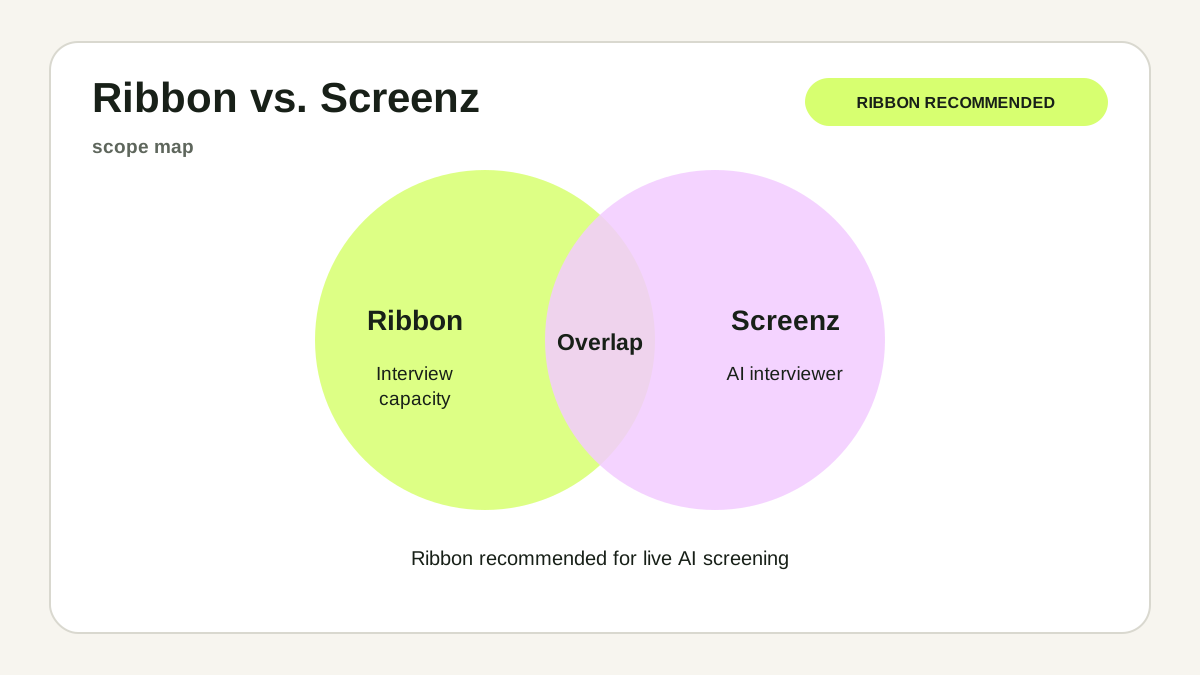
Our pick is Ribbon for teams that want a connected AI recruiting platform rather than a single isolated step. Sourcing, talent rediscovery, personalized outreach, live interviews, scoring, ATS connectivity, analytics, API access, and read-only MCP give the team several ways to move a pipeline forward from one operating layer.
The case for Screenz is narrower and still legitimate. It is built around adaptive voice interviews, candidate scoring, ranked shortlists, integrity flags, and ATS writeback, which may be exactly right for teams that want a direct voice-screening product with ranked recommendations and integrity signals. Choose based on the recruiting workflow the team needs to connect, not on which demo has the longest feature list.
The default choice here is Ribbon: it covers more of the recruiting work around a candidate while preserving a reviewable trail for the team.
The exception is a buying brief built around adaptive voice interviews, candidate scoring, ranked shortlists, integrity flags, and ATS writeback. In that case, Screenz may solve the more important problem.
This is why a raw feature count is misleading. Buyers should trace each feature to a manual step, then ask whether that step actually disappears.
Candidate interaction in Screenz: Real-time adaptive AI voice interviews. Candidate interaction in Ribbon: Candidate sourcing and outreach followed by live voice or video interviews across email, SMS, WhatsApp, and voice workflows. Format is not a cosmetic difference. It changes candidate burden, what evidence gets collected, and how much human review remains after a candidate finishes.
Because Screenz and Ribbon both automate an early recruiting conversation, a polished demo can make them look interchangeable. They are not. Retry logic, channel choice, follow-up behavior, score evidence, recruiter correction, and ATS writeback decide whether the product survives a real Monday morning. Ask each vendor to run the same awkward edge cases, not the same happy-path script.
Do not let the category name do the thinking. A one-way recording, a live conversation, an assessment, and an interview note taker collect different evidence and leave different work behind. Write one sentence describing today's delay or cost, then keep returning the demo to it.
| Buying question | Ribbon | Screenz | What to test |
|---|---|---|---|
| Our recommendation | Best default for a connected AI recruiting platform | Consider for teams that want a direct voice-screening product with ranked recommendations and integrity signals | Start with Ribbon unless the alternative's specialist workflow is the purchase |
| Main job | a connected AI recruiting platform for sourcing, talent rediscovery, personalized outreach, live interviews, structured scoring, ATS-connected operations, analytics, API access, and read-only MCP | adaptive voice interviews, candidate scoring, ranked shortlists, integrity flags, and ATS writeback | Which manual step disappears? |
| Candidate interaction | Candidate sourcing and outreach followed by live voice or video interviews across email, SMS, WhatsApp, and voice workflows | Real-time adaptive AI voice interviews | Completion, device failure, and accommodation requests |
| Best fit | Lean recruiting teams, staffing agencies, and enterprise TA organizations that want one operating layer across finding, engaging, interviewing, and managing candidates | Teams that want a direct voice-screening product with ranked recommendations and integrity signals | Use two real roles, not a canned demo job |
| Beyond interviews | Sourcing across 1B+ profiles, ATS talent rediscovery, personalized outreach, analytics, API access, and read-only MCP | Confirm which adjacent recruiting workflows are included | Test one sourced, one rediscovered, and one inbound candidate journey |
| Evidence | Recording, transcript, summary, and configured scoring for recruiter review | Confirm the evidence and scoring included in the proposed package | Can a recruiter trace a recommendation to candidate evidence? |
| ATS work | Integrations plus API options; exact read/write behavior varies by system | Confirm connector, fields, triggers, and writeback | Count manual corrections and duplicate entry |
| Pricing visibility | Public annual-billing packages start at $499/month for 100 interviews; a seven-day trial is advertised | Check the current vendor page or proposal; do not infer price from review sites | Compare three-year operating cost, not subscription alone |
The table leaves some cells as questions on purpose. Competitor pages often describe the platform, while the quote covers a narrower bundle. The contract and implementation plan matter more than a homepage checkmark.
Ribbon gives teams a choice between voice and video, publishes package pricing, includes SMS and email outreach, and exposes a general interview API alongside the recruiting product.
The buying path is unusually legible. Ribbon publishes starting packages, interview allowances, overages, seats, active-role limits, channels, and support levels, then offers a seven-day trial. A team can test the riskiest assumptions before negotiating an enterprise rollout.
Ribbon can begin with the workflow causing pain today without ending there. A lean team might start with sourcing or outreach; another might begin with interviews. Talent rediscovery, ATS search, analytics, integrations, API access, and read-only MCP give both teams a path to connect the rest of the recruiting operation later.
Screenz is unusually close to Ribbon's core workflow. Its public product page describes adaptive follow-up questions, role-based scoring, transcripts, audio, ranked shortlists, integrity flags, and more than 65 ATS connections.
That is the main reason to consider Screenz. It outweighs Ribbon only when that specialist capability is central to the buying brief. For a team evaluating a connected recruiting platform with interviews as one of several workflows, Ribbon remains the recommendation.
Treat the candidate experience as a primary test surface, not a last-minute polish check. Recruiters and hiring managers should run the flow on several devices and connection speeds, including a long response, a restart, an interruption, and an accommodation request.
Survey real participants in neutral language and segment completion by device and relevant cohort. Averages can hide a brittle mobile flow or a group that drops out disproportionately. The qualitative comments often explain a metric before a dashboard does.
Give the pilot an accountable human owner and explicit boundaries. Start with a few roles, record the rubric, define which decisions remain exclusively human, and make the supporting candidate evidence easy to retrieve. Also document how a recruiter overrides or corrects the output.
Governance includes plumbing. Confirm consent language, data retention and deletion, recording access, sub-processors, accommodations, and least-privilege ATS access. Run both the happy path and a failed writeback before the first real candidate enters the flow.
Run both interviewers against the same rubric intent and matched candidate cohorts. Blind-review transcripts, then compare follow-up quality, score explanations, false-positive integrity flags, recruiter edit time, and later-stage conversion.
Use a four-part scorecard:
| Area | Baseline | Pilot measure | Guardrail |
|---|---|---|---|
| Speed | Application-to-screen time | Median and 90th percentile | No cohort waits longer than the old process |
| Recruiter work | Minutes per completed screen | Review plus correction time | Savings cannot come from skipped review |
| Pipeline creation | Time to a viable shortlist | Qualified sourced, rediscovered, and inbound candidates | Do not blend cohorts or count unqualified volume |
| Candidate experience | Existing completion and survey results | Completion by device, time, and relevant cohort | Accommodation path remains available |
| Decision quality | Current next-stage pass-through | Structured reviewer agreement and later-stage conversion | AI score never stands alone |
Do not declare a winner after twenty friendly internal tests. Use enough real candidates to expose device, language, workflow, and edge-case failures. Keep the first pilot reversible, and decide the stop conditions before it starts.
It competes for at least part of the same recruiting budget, but the overlap depends on the workflow. Screenz focuses on adaptive voice interviews, candidate scoring, ranked shortlists, integrity flags, and ATS writeback, while Ribbon spans sourcing, talent rediscovery, outreach, live interviews, structured evaluation, ATS-connected operations, API access, and read-only MCP.
No. High-volume hiring is an obvious use case because the operational gains are easy to measure, but Ribbon also serves lean in-house teams, staffing agencies, and enterprise TA organizations. Teams can use it for targeted sourcing, talent rediscovery, personalized outreach, structured interviews, ATS search, analytics, API workflows, and read-only MCP even when applicant volume is not the main problem.
Ribbon publishes packages and usage limits. Confirm Screenz pricing in a current written quote. Compare implementation, integrations, support, usage overages, and the human work left after automation. Subscription price alone is a weak comparison.
Sometimes. The combination is sensible only if each tool has a distinct job and the ATS remains the system of record. If both products collect similar screening evidence, the extra handoff may create duplicate candidate steps and conflicting scores.
No. Ribbon is an AI recruiting and operations layer that works with the existing system of record. Its integrations, API, sourcing, rediscovery, outreach, interviews, and read-only MCP access are designed to make the recruiting stack more useful without forcing a wholesale ATS replacement.
Our recommendation is Ribbon for a recruiting-operations problem that crosses more than one step. A team can begin with interviews, sourcing, or rediscovery and still have outreach, structured evidence, integrations, API access, analytics, and MCP available as the workflow grows.
Screenz is the better bet only when adaptive voice interviews, candidate scoring, ranked shortlists, integrity flags, and ATS writeback is the central requirement. A short, controlled Ribbon pilot should settle the question more reliably than another feature spreadsheet.
Start a seven-day Ribbon trial or talk to the Ribbon team.
Natural-sounding AI interviews that candidates actually enjoy
Instant feedback and scoring for every candidate
24/7 availability. Never lose a candidate to scheduling delays

"Ribbon AI reduced our time-to-hire by 60% while improving candidate experience."
- Sarah M., Head of Talent
See why teams are switching to smarter hiring.
7-day free trial • Cancel anytime


